7th Pay Commission 2025: Latest Updates, Changes & What Central Government Employees Should Know
Introduction
The 7th Central Pay Commission (7th CPC) has been a cornerstone of central government salary structure and allowances since its implementation. As we approach the end of its cycle, 2025 is a critical year with several important updates, modifications, and preparations for what may come next. For millions of government employees and pensioners, understanding these changes is key to planning finances, knowing benefits, and anticipating the transition to future pay structures.
In this article, we explore the latest developments as of 2025: salary hikes, revised allowances, government orders, challenges, and the transition roadmap. We also highlight what these mean practically for employees and pensioners under the 7th Pay Commission regime.
Background: What is the 7th Pay Commission?
Before diving into 2025 updates, it helps to recap the significance of the 7th CPC:
- The 7th Pay Commission was set up to revise pay scales, allowances, pensions, and other benefits of central government employees. Its recommendations were implemented beginning in 2016.
- It introduced a new pay matrix, changed the structure of allowances, and aimed to simplify and rationalize salary components.
- Key components under 7th CPC include basic pay, Dearness Allowance (DA), House Rent Allowance (HRA), and various other special, risk, and transport allowances.
Over the years, revisions (especially of DA) and reinterpretation of allowance rules have ensured that the pay system remains dynamic and responsive to inflation and cost-of-living changes.
Major Updates & Clarifications in 2025 for 7th Pay Commission
In 2025, several significant developments have emerged under the 7th Pay Commission, affecting both serving employees and retirees. Here are the most important ones:
1. Dress Allowance Revisions and Proportionate Payments
One of the key updates concerns dress allowance, which is given to central government employees in certain categories who require uniforms or formal attire. Several clarifications and rule changes were issued in 2025:
- The Ministry of Finance (Department of Expenditure) issued a circular (Office Memorandum dated March 24, 2025) modifying the guidelines on dress allowance.
- Under the revised rules, employees joining after July 1, 2025, will receive dress allowance on a proportionate basis rather than full annual amount.
- A later clarification (circular dated September 24, 2025) stated that employees retiring mid-year (after July 30, 2025) will also be eligible for proportionate dress allowance with their salary of July 2025.
- However, for retirees whose service ends in October 2025 or later, any excess payments may be recovered by the government.
- The intention appears to be ensuring consistency: new employees and retiring employees mid-year are treated under similar proportionate rules for dress allowance.
These changes affect budgeting, payroll, and planning for many employees, especially those who join or retire mid-financial year.
2. Dearness Allowance (DA) Updates & Final Hike
Dearness Allowance (DA) is a critical component linked to inflation, and 2025 has seen notable movements:
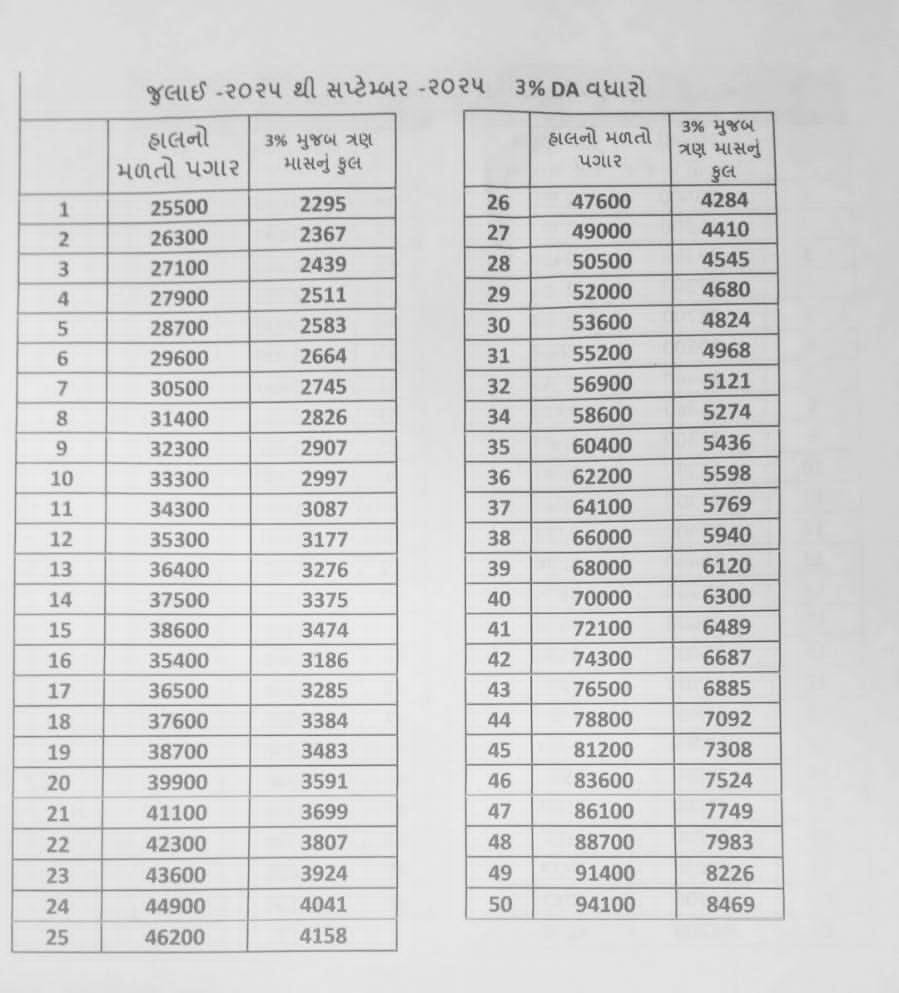
- As of January 2025, DA was revised to 55% of basic pay for central government employees, following a prior hike (from 53% to 55%).
- Analysts expect further DA increases, considering the rising Consumer Price Index (CPI-IW). For example, a ~57-58% DA was projected based on recent CPI trends and calculations.
- News reports suggest that the 2025 hikes in DA may be among the last under the 7th CPC, as discussions for the 8th Pay Commission gain momentum.
- Some states (e.g., Gujarat) have also revised DA for state employees under both 6th and 7th CPC in 2025.
Thus, employees and pensioners are closely watching DA trends, as they directly impact real income and financial planning.
3. Extension of Certain Concessions and Allowances
Other updates in 2025 include:
- The government has extended benefits and concessions for employees in special zones, such as the Kashmir Valley for another three years from August 1, 2024.
- Allowance structures and eligibility continue to be reviewed and clarified, especially for categories like new recruits, retirees, and special duty allowances. These clarifications affect how benefits are computed and disbursed in practice.
4. Legal & Administrative Orders Affecting Beneficiaries
2025 also witnessed legal challenges and court orders about extending 7th CPC benefits:
- In Madhya Pradesh, the High Court ordered that professors of government-aided colleges (appointed before certain dates) must receive 7th CPC benefits retrospectively.
- These judicial interventions highlight ongoing gaps in implementation across states and institutions, and reinforce that benefits under 7th CPC are still contested in certain areas.
Impacts: What These Changes Mean for Employees & Pensioners
Now let’s look at how the 2025 developments under the 7th Pay Commission affect various stakeholders.
Serving Employees
- Better salary stability: With DA hikes and clarified allowance rules (especially dress allowance), employees have more predictable income and benefits.
- Budget planning mid-year: Proportionate dress allowance rules mean those joining or retiring mid-year must adjust expectations on their compensation.
- Rising costs of living: Even with DA increases, inflation pressures continue, making regular revisions necessary.
- Transition uncertainty: As 8th Pay Commission discussions intensify, employees may delay long-term financial decisions (e.g., investments, pension planning) until new pay structures are formalized.
Pensioners
- DR (Dearness Relief) linked to DA: Pensioners benefit from DA hikes through increased DR, helping maintain purchasing power amidst inflation.
- Arrears & legal benefits: Court rulings that extend 7th CPC benefits can result in additional pension arrears for retirees, improving financial security.
- Uncertainty with pay commission transition: The switch to 8th CPC may bring changes in pension formula, fitment factors, and benefit structure, so pensioners remain cautious.
Government & Payroll Administration
- Budgetary implications: DA hikes, allowance modifications, and arrears impose significant fiscal pressure on the central budget.
- Implementation challenges: Ensuring proportionate payments, reconciling retirements, and adjusting payroll systems for new rules (e.g., dress allowance) require administrative effort.
- State coordination: Since many states adopt or mirror central pay commission norms, variations in implementation lead to demands, litigation, and policy adjustments.
What to Expect Next: Towards the 8th Pay Commission
As 2025 progresses, the transition from the 7th Pay Commission to the 8th Pay Commission is increasingly likely. Here’s what may happen and what employees should watch out for:
Key considerations for 8th Pay Commission
- Fitment factor revision: It’s expected that the new commission will propose a fresh fitment factor, which determines how basic pay is calculated from previous pay scales.
- Resetting DA & DR: Often, when a new pay commission is implemented, DA/DR baselines are reset. That means even if DA is high at the end of 7th CPC, new calculations may treat it differently.
- New pay matrix & allowances: Allowances (HRA, transport, risk, uniform) may be restructured, leading to changes in overall take-home salary even if basic pay increases.
- Timeline & arrears: Implementation may take months or years; arrears usually accumulate from a set date (often Jan 1 of a year) until actual rollout. Reddit discussions suggest possibility of delays.
Risks and issues employees should be aware of
- Delays in notification & implementation may affect financial planning and cost-of-living adjustments.
- Temporary freezing or slower growth of allowances during the transition period.
- Changes in rules might favor some levels or categories of employees more than others, leading to perceptions of inequality.
How to Prepare & Stay Informed in 2025 (for Employees, Pensioners, HR, & Policy Planners)
To navigate this transitional period effectively, here are practical tips and recommendations:
- Track official circulars and orders: Keep an eye on the Department of Expenditure, Ministry of Finance, and staff-related notifications for changes in DA, dress allowance, HRA, etc.
- Monitor CPI/IW trends: Since DA is tied to inflation indices, understanding CPI movements helps anticipate upcoming DA hikes.
- Understand your classification & level: Allowance entitlements vary by cadre, level, city type, and uniform requirements. Get clarity on where you fall.
- Plan for arrears: If changes are retrospective, budget expectations might include back pay, but actual disbursal may be delayed.
- Engage with staff unions & legal updates: Many benefit decisions emerge via litigation or collective bargaining; staying connected helps stay ahead of changes.
- Prepare for the 8th CPC: Save, review pension plans, and adjust financial decisions knowing that benefit structure may shift significantly.
Challenges & Criticisms of the 7th CPC as 2025 Ends
While the 7th Pay Commission has brought many improvements, several challenges persist, especially as we near its conclusion:
- Inflation lag: Even with DA adjustments, there are concerns that salary increases haven’t kept pace with rising living costs in many regions.
- Unequal benefits: Some allowances and benefits vary sharply between cadres, departments, states, and city classifications, causing perceived unfairness.
- Implementation gaps: As seen in state court cases (e.g., Madhya Pradesh professors), not all beneficiaries receive timely or full benefits.
- State-centre divergence: States may interpret or adopt central pay commission recommendations differently, causing disparities for state employees.
- Uncertainty over the transition: The shift to the 8th CPC may create interim confusion and financial stress for employees awaiting new norms.
Loading Viewer...
Conclusion
DA / DR Calculator અને ફાઇલ્સ ડાઉનલોડ
| અગત્યની લિંક્સ 🖇️ | ડાઉનલોડ / જુઓ |
|---|---|
| 💸 3% મોંઘવારી વધારા ઓફિસીય પરિપત્ર PDF | અહીં ક્લિક કરો |
| 💸 58% મોંઘવારી કોઠો PDF ડાઉનલોડ કરવા માટે | અહીં ક્લિક કરો |
| 💸 જુલાઈ 2024 ઇજાફા સાથેનો તફાવત | અહીં ક્લિક કરો |
| 💸 જાન્યુઆરી 2024 ઇજાફા સાથેનો તફાવત | અહીં ક્લિક કરો |
| ✅ 42% માંથી 46 % મોંઘવારી પગાર કેટલો વધે તે જોવો (માત્ર બેઝિક નાખો) | અહીં ક્લિક કરો |
The 7th Pay Commission in 2025 remains highly relevant for central government employees and pensioners. With new circulars, DA hikes, revised allowance rules, and ongoing debates about the 8th Commission, the current year is pivotal for income, benefits, and future policymaking.
મહત્ત્વપૂર્ણ લિંક્સ 🖇️
👉 46% મોંઘવારી વધારા બાદ તમને કેટલો પગાર મળશે જોવા માટે અહીં ક્લિક કરો.
👉 46% મોંઘવારી મુજબ તફાવતની ગણતરી

For employees, staying informed, understanding personal classification, and planning for the transition to 8th CPC are essential. Pensioners must track DR and arrears, while the government and HR departments need to ensure smooth implementation and fair treatment.
As India moves towards the next pay commission, the lessons from 7th CPC — especially in terms of transparency, fairness, and responsiveness to inflation — will be critical benchmarks in shaping future salary and benefits policy.
If you like, I can prepare a fully SEO-optimized article with suggested metadata, headings, keyword strategy, and even infographics for “7th Pay Commission 2025” targeted at Indian government employees. Do you want me to draft that for your blog or website?
