GSEB Books Change 2026–27: Complete List of New Textbooks, Medium-Wise Changes & Official Circular Explained
The Gujarat State School Textbook Board (GSEB) has officially announced important textbook changes for the academic year 2026–27. As per the latest circular released from Vidya Bhavan, Sector-10/A, Gandhinagar, several new and revised textbooks will be implemented across primary and upper primary classes in different mediums including Gujarati, English, Hindi, Marathi, Urdu, and Sanskrit .
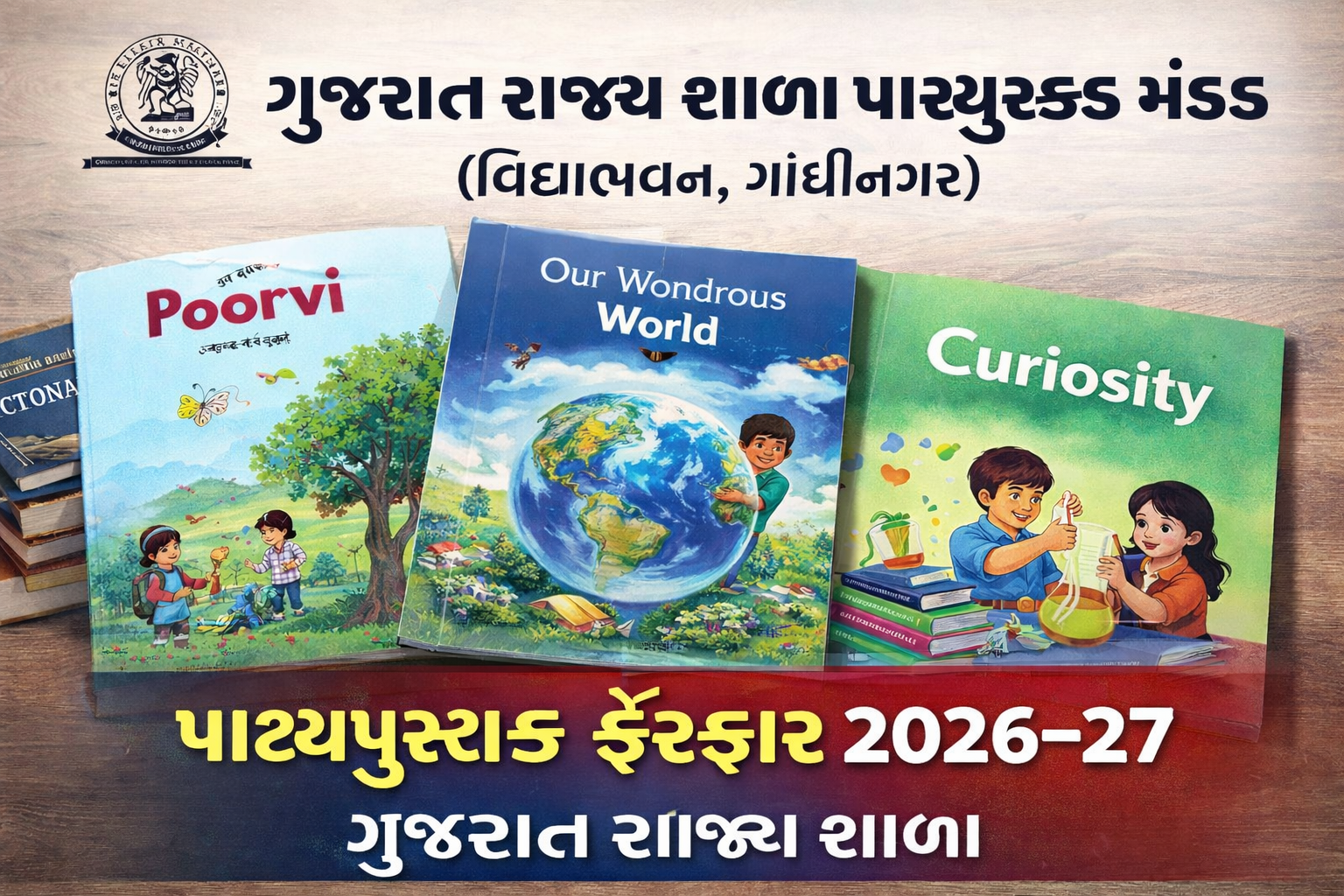
This decision is aligned with NCERT curriculum integration and aims to bring uniformity, conceptual clarity, and modern learning outcomes for students across Gujarat.
In this article, you will get:
- Full details of GSEB book changes 2026–27
- Class-wise and subject-wise list
- Medium-wise explanation
- Impact on students, teachers, and schools
- FAQs & official guidance
Overview of GSEB Textbook Changes 2026–27
The Gujarat State School Textbook Board has clarified that these updates are part of a planned academic reform, ensuring that learning materials are:
- Concept-oriented
- Age-appropriate
- Aligned with NCERT standards
- Inclusive of multiple language mediums
These changes apply to standards 1 to 8, and some updates extend to standards 9 and 11 for specific subjects.
Why Has GSEB Changed Textbooks for 2026–27?
The key reasons behind the textbook changes include:
🔹 Alignment with NCERT
GSEB aims to bring Gujarat’s syllabus closer to the national curriculum framework, ensuring competitive academic standards.
🔹 Improved Learning Outcomes
The new books focus on:
- Conceptual understanding
- Critical thinking
- Activity-based learning
🔹 Uniform Curriculum Across Mediums
Gujarati, English, Hindi, Marathi, Urdu, and Sanskrit medium students will now study standardized content.
Class-Wise & Subject-Wise GSEB New Books List (2026–27)
Below is a simplified explanation of the official list mentioned in the circular.
Primary Section (Standards 1 to 5)
Languages
- Gujarati (First Language & Second Language)
- English (First Language)
- Hindi (First Language)
- Urdu (First Language)
Books like:
- Santoor
- Veena
- Sitar
- Poorvi
- Malhar
- Khayaal
are newly aligned or revised for conceptual progression.
Environmental Studies & Social Science
- Our Wondrous World – Standard 3
- Exploring Society: India and Beyond – Standard 5
These books introduce:
- Observation-based learning
- Local-to-global understanding
- Real-life examples
Science & Curiosity-Based Learning
- Curiosity – Standard 5
- General Science (Primary Level)
These books emphasize:
- Inquiry-based learning
- Practical thinking
- Daily life science connections
Upper Primary Section (Standards 6 to 8)
Languages
- Gujarati, Hindi, English, Marathi, Urdu, Sanskrit
Subjects Introduced / Revised
- Mathematics
- Science
- Social Science
- Computer Education
- Health & Physical Education
The books are revised to support:
- Logical reasoning
- Digital awareness
- Holistic development
Standards 9 & 11 (Selective Subjects)
Some supplementary or subject-specific books for:
- Gujarati
- English
- Hindi
have also been included as per the circular.
Medium-Wise Implementation
The textbook changes apply across the following mediums:
| Medium | Status |
|---|---|
| Gujarati | ✅ Implemented |
| English | ✅ Implemented |
| Hindi | ✅ Implemented |
| Marathi | ✅ Implemented |
| Urdu | ✅ Implemented |
| Sanskrit | ✅ Implemented |
This ensures equal academic quality for all students, regardless of language medium.
Instructions for Schools & Teachers
As per the circular:
- Schools must replace old editions with new textbooks.
- Teachers should follow revised learning outcomes.
- Training & orientation may be conducted at cluster/district levels.
- Old stock of books should not be used from 2026–27 onwards .
Impact on Students
Students will benefit through:
- Simplified explanations
- Concept-based chapters
- Better exam preparedness
- Alignment with competitive exams
Impact on Teachers
Teachers will experience:
- Updated teaching framework
- Easier lesson planning
- Activity-oriented pedagogy
Impact on Parents
Parents should:
- Ensure children have new editions only
- Avoid using previous year textbooks
- Follow school instructions carefully
Availability of New GSEB Textbooks
New books will be available via:
- Government textbook distribution channels
- Authorized book depots
- School-wise allocation
Schools will inform parents regarding:
- Purchase dates
- Distribution process
Important Points to Remember
✔ These changes are mandatory
✔ Applicable from academic year 2026–27 only
✔ Based on official GSEB circular
✔ NCERT-aligned curriculum
Frequently Asked Questions (FAQs)
Q1. Are old GSEB books valid in 2026–27?
No. Only newly approved textbooks are valid.
Q2. Do these changes apply to private schools?
Yes, all schools following GSEB syllabus must comply.
Q3. Are exams based on new books?
Yes, examinations will strictly follow revised textbooks.
Q4. Is the change applicable to all mediums?
Yes, Gujarati, English, Hindi, Marathi, Urdu & Sanskrit.
Conclusion
The GSEB Books Change 2026–27 is a major educational reform aimed at improving learning quality, ensuring NCERT compatibility, and offering equal academic opportunities across all mediums. Students, teachers, and parents must adapt to these changes to ensure a smooth academic transition.
If you are preparing for the 2026–27 academic year, make sure you follow only the latest GSEB textbook list issued by the Gujarat State School Textbook Board .
🔔 Tip for Bloggers
You can target keywords like:
- GSEB new books 2026–27
- Gujarat textbook change
- GSEB syllabus update
- NCERT alignment Gujarat
