Gujarat Introduces Holistic Progress Card (HPC) for Balvatika and Classes 1–2: Complete Guide 2025–26
The Government of Gujarat has taken another major step towards transforming school education by introducing the Holistic Progress Card (HPC) for Balvatika and Classes 1 and 2 from the academic year 2025–26. This initiative aligns with the National Education Policy (NEP) 2020 and the National Curriculum Framework for Foundational Stage (NCF-FS 2023).
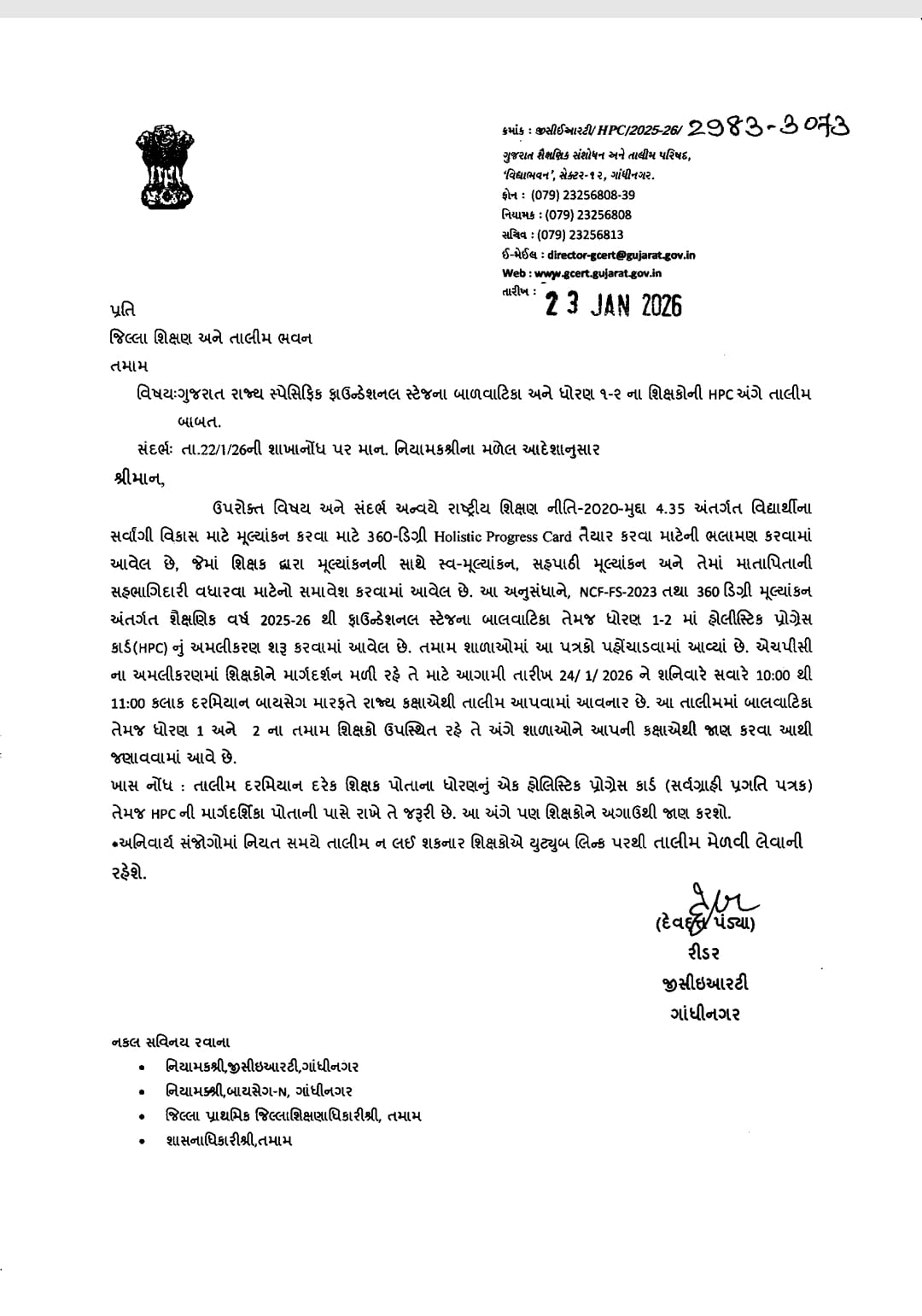
As per the official circular issued by the State Council of Educational Research and Training (SCERT), Gandhinagar, dated 23 January 2026, the HPC will be implemented across all government schools in Gujarat to ensure 360-degree assessment of students.

This article explains everything you need to know about the Holistic Progress Card – meaning, objectives, features, benefits, implementation process, and its impact on students and teachers.
What is Holistic Progress Card (HPC)?
The Holistic Progress Card (HPC) is a new assessment system designed to evaluate students not only on academic performance but also on their overall development.
Unlike traditional report cards that focus mainly on marks and exams, the HPC emphasizes:
- Learning outcomes
- Skills and competencies
- Social and emotional growth
- Creativity and participation
- Physical and moral development
In simple words, HPC measures how a child is growing as a person, not just how many marks they score.
Why Was HPC Introduced?
The introduction of HPC is based on the vision of NEP 2020, which aims to shift education from:
Rote learning → Conceptual understanding
Marks → Mastery of skills
Exams → Continuous assessment
The traditional examination system often creates stress, competition, and fear among young learners. HPC removes this pressure and encourages joyful, child-centric learning.
HPC and National Education Policy 2020
The National Education Policy 2020 clearly states that:
- Assessment should be regular and formative
- Focus should be on competency-based learning
- Students should be evaluated on multiple dimensions
HPC is a direct implementation of Clause 4.35 of NEP 2020, which recommends a 360-degree Holistic Progress Card.
HPC and NCF-FS 2023
The National Curriculum Framework for Foundational Stage (NCF-FS 2023) focuses on children aged 3 to 8 years, covering:
- Balvatika (Pre-primary)
- Classes 1 and 2
It emphasizes learning through:
- Play
- Activities
- Storytelling
- Interaction
- Exploration
HPC supports this framework by tracking development in all these areas.
Classes Covered Under HPC in Gujarat
According to the official circular:
HPC will be implemented for:
- Balvatika (Pre-primary)
- Class 1
- Class 2
This applies to:
- All government primary schools
- All government-aided schools
- Schools under Gujarat Education Department
Key Features of Holistic Progress Card
1. 360-Degree Assessment
Students are evaluated on:
- Academic learning
- Behaviour and attitude
- Participation
- Creativity
- Physical activities
- Social skills
2. No Exam Pressure
There are no traditional written exams for HPC at this level.
3. Continuous Evaluation
Assessment happens throughout the year through:
- Classroom activities
- Projects
- Group work
- Observations
4. Self-Assessment
Students are encouraged to reflect on:
- What they learned
- What they enjoyed
- Where they need help
5. Peer Assessment
Children learn to appreciate and evaluate each other.
6. Teacher Observation
Teachers act as mentors and guides, not just examiners.
Objectives of HPC
The main objectives of the Holistic Progress Card are:
- To promote joyful learning
- To reduce exam stress
- To encourage natural curiosity
- To identify strengths and weaknesses
- To develop life skills
- To ensure inclusive education
- To involve parents in learning process
How Will HPC Be Implemented in Gujarat?
Teacher Training Session
As per the circular, SCERT has organized an online state-level training session for teachers.
Training Details:
- Date: 24 January 2026
- Time: 10:00 AM to 11:00 AM
- Mode: Online (State level)
- Participants: All Balvatika, Class 1 and 2 teachers
This session provides guidance on:
- How to use HPC
- How to assess students
- How to fill HPC formats
- How to give feedback
Role of Teachers in HPC
Teachers play the most important role in the success of HPC.
Their responsibilities include:
- Observing students regularly
- Recording progress
- Giving constructive feedback
- Encouraging participation
- Communicating with parents
Teachers will no longer be limited to checking notebooks and tests, but will become facilitators of growth.
Role of Parents in HPC
Parents are active partners in this system.
They can:
- Understand child’s strengths
- Support learning at home
- Give feedback to teachers
- Track emotional development
HPC creates strong school–parent connection.
Domains Covered in HPC
HPC evaluates students across five major domains:
1. Cognitive Development
- Reading
- Writing
- Basic numeracy
- Problem solving
2. Physical Development
- Motor skills
- Fitness
- Coordination
- Health habits
3. Social Development
- Teamwork
- Respect
- Sharing
- Leadership
4. Emotional Development
- Confidence
- Empathy
- Self-control
- Expression
5. Creative Development
- Art
- Music
- Storytelling
- Innovation
Benefits of Holistic Progress Card
For Students
- Stress-free learning
- Better confidence
- Individual attention
- Skill-based growth
- Love for school
For Teachers
- Better understanding of students
- Effective teaching methods
- Less exam burden
- Professional development
For Parents
- Clear picture of child’s growth
- Improved communication
- Early problem detection
For Education System
- Quality education
- Reduced dropout rate
- Inclusive learning
- Global standards
Difference Between Traditional Report Card and HPC
| Traditional Report Card | Holistic Progress Card |
|---|---|
| Marks-based | Skill-based |
| Exam-focused | Activity-based |
| Competitive | Collaborative |
| Stressful | Joyful |
| One-dimensional | Multi-dimensional |
Challenges in Implementing HPC
While HPC is a powerful reform, some challenges include:
- Teacher workload
- Training requirements
- Mindset change
- Parental awareness
- Digital infrastructure
However, with proper training and support, these challenges can be overcome.
Future Impact of HPC in Gujarat
The Holistic Progress Card will:
- Improve foundational learning
- Create confident learners
- Reduce learning gaps
- Prepare students for future skills
- Build strong educational foundation
This reform will shape India’s next generation into responsible, skilled, and emotionally intelligent citizens.
Conclusion
The introduction of the Holistic Progress Card (HPC) in Gujarat for Balvatika and Classes 1–2 is a revolutionary step in Indian education.
It marks a shift from:
Marks to Meaningful Learning
Exams to Experiences
Competition to Collaboration
By implementing HPC, Gujarat is aligning itself with global education standards and the true spirit of NEP 2020.
This initiative ensures that every child is not just a topper in exams, but a confident, creative, compassionate human being.
SEO Keywords (for your blog)
- Holistic Progress Card Gujarat
- HPC 2025-26
- NEP 2020 assessment system
- Gujarat education news
- Balvatika assessment
- Class 1 2 new evaluation system
- NCF-FS 2023
- 360 degree student assessment
- SCERT Gujarat circular
- New education policy Gujarat
