Reading Skills and Numeracy Skills Rubric: Complete Guide for Student Assessment (10 Point Scale)
In today’s education system, student assessment is not limited to just marks or exam scores. Schools and teachers now focus on holistic evaluation, which includes skills like reading comprehension and numeracy abilities. To measure these skills effectively, many institutions use a Rubric-based Assessment System.

This article explains in detail the Reading Skills Rubric and Numeracy Skills Rubric (10 Point Scale), their categories, meanings, benefits, and how teachers and parents can use them for better learning outcomes.
What is a Rubric in Education?
A rubric is a scoring guide used to evaluate students’ performance based on specific criteria. Instead of just giving marks, a rubric describes:
- Level of understanding
- Quality of performance
- Strengths and weaknesses
- Areas for improvement
Rubrics help in fair, transparent, and meaningful assessment.
Importance of Reading and Numeracy Skills
1. Reading Skills
Reading is the foundation of all learning. A child who reads well can:
- Understand textbooks better
- Improve vocabulary
- Perform well in all subjects
- Develop critical thinking
2. Numeracy Skills
Numeracy is the ability to understand and work with numbers. It helps in:
- Basic arithmetic
- Logical thinking
- Problem solving
- Real-life applications like money, time, and measurement
Both skills are essential for academic success and lifelong learning.
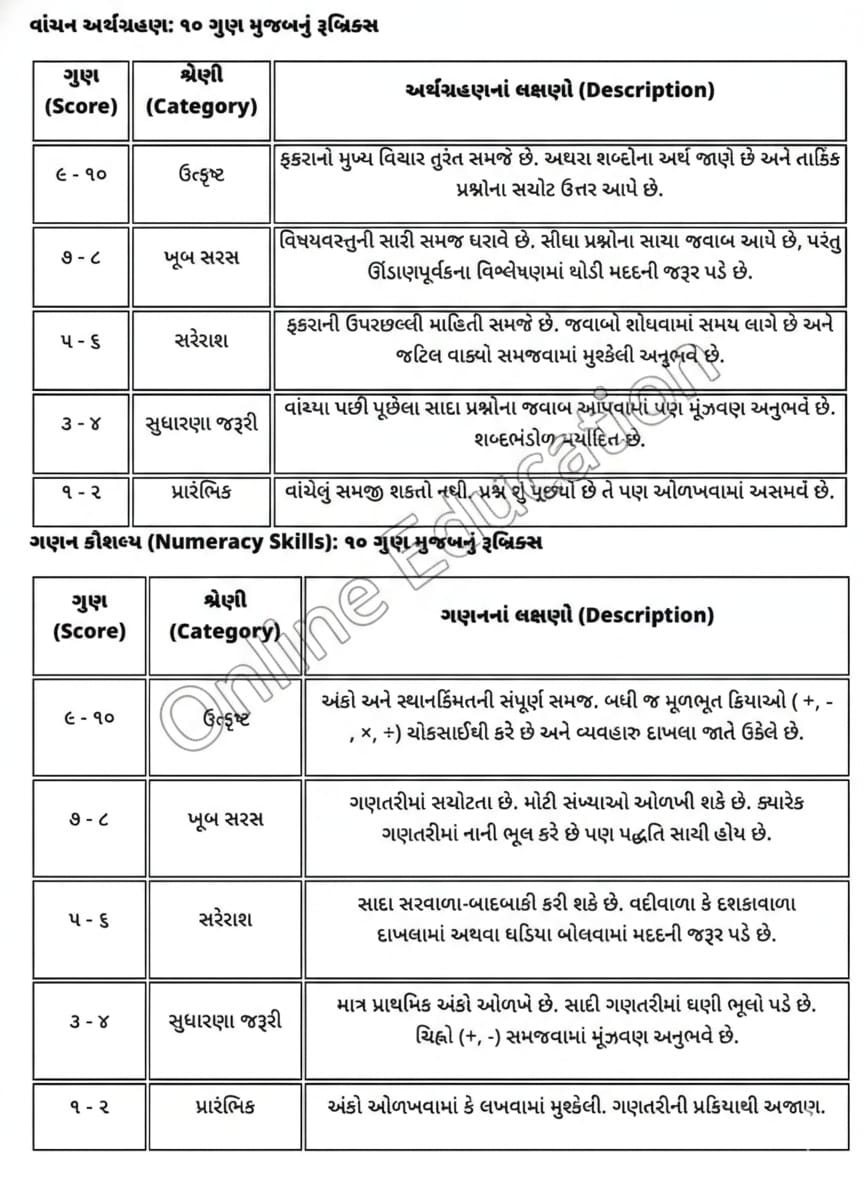
Reading Skills Rubric (10 Point Scale)
The Reading Skills Rubric evaluates a student’s ability to understand and respond to written text.
Score Categories
| Score | Category | Meaning |
|---|---|---|
| 8–10 | Excellent (ઉત્તમ) | High-level understanding |
| 6–7 | Very Good (ખૂબ સરસ) | Good comprehension |
| 4–5 | Average (સરેરાશ) | Basic understanding |
| 3–4 | Needs Improvement (સુધારણા જરૂરી) | Struggles with meaning |
| 1–2 | Beginner (પ્રારંભિક) | Very limited skills |
1. Excellent (8–10)
Students in this category:
- Clearly understand the main idea
- Know word meanings
- Answer questions correctly
- Can summarize the text
- Show critical thinking
These students are independent readers.
2. Very Good (6–7)
These students:
- Understand most of the content
- Answer direct questions correctly
- May struggle slightly with deep meaning
- Need minor guidance
They are good readers but need polishing.
3. Average (4–5)
Students:
- Understand surface-level information
- Take time to answer questions
- Find long sentences difficult
- Miss hidden meanings
They need regular practice and support.
4. Needs Improvement (3–4)
These learners:
- Struggle with comprehension
- Feel confused after reading
- Have limited vocabulary
- Find it hard to express answers
They require special attention and remedial teaching.
5. Beginner (1–2)
Students:
- Cannot understand the text
- Cannot answer even simple questions
- Have poor reading habits
- Lack confidence
They need foundational literacy training.
Numeracy Skills Rubric (10 Point Scale)
The Numeracy Skills Rubric evaluates a student’s understanding of numbers and basic mathematical operations.
Score Categories
| Score | Category | Meaning |
|---|---|---|
| 8–10 | Excellent (ઉત્તમ) | Strong math skills |
| 6–7 | Very Good (ખૂબ સરસ) | Accurate calculations |
| 4–5 | Average (સરેરાશ) | Basic operations |
| 3–4 | Needs Improvement (સુધારણા જરૂરી) | Conceptual difficulty |
| 1–2 | Beginner (પ્રારંભિક) | Weak number sense |
1. Excellent (8–10)
Students:
- Understand place value
- Perform +, –, ×, ÷ correctly
- Apply math in real-life situations
- Solve word problems easily
They have strong numerical intelligence.
2. Very Good (6–7)
Students:
- Perform calculations accurately
- Make small mistakes
- Understand logic behind answers
- Use correct methods
They just need more practice for perfection.
3. Average (4–5)
Students:
- Can do simple calculations
- Struggle with word problems
- Make frequent errors
- Need step-by-step guidance
They require concept reinforcement.
4. Needs Improvement (3–4)
Students:
- Know only basic counting
- Confused with + and –
- Forget formulas
- Lack problem-solving skills
They need conceptual clarity and practice.
5. Beginner (1–2)
Students:
- Cannot recognize numbers properly
- Struggle with basic operations
- Fear mathematics
- Show low confidence
They need remedial math programs.
Benefits of Using Rubric-Based Assessment
1. For Teachers
- Clear evaluation system
- Saves time in grading
- Identifies weak students
- Helps in lesson planning
2. For Students
- Understand their level
- Know areas to improve
- Reduces exam fear
- Boosts self-confidence
3. For Parents
- Easy to understand progress
- No confusion about marks
- Helps in home support
- Better communication with teachers
How Schools Can Implement This Rubric
Step 1: Regular Assessment
Conduct monthly reading and math tests.
Step 2: Categorize Students
Assign scores based on rubric.
Step 3: Group Learning
Create groups:
- Advanced learners
- Average learners
- Slow learners
Step 4: Remedial Teaching
Provide extra classes for low scorers.
Step 5: Track Progress
Compare scores every term.
Activities to Improve Reading Skills
- Daily reading practice
- Storytelling sessions
- Vocabulary games
- Reading aloud
- Comprehension worksheets
Activities to Improve Numeracy Skills
- Mental math games
- Flash cards
- Real-life math problems
- Abacus practice
- Math apps and puzzles
Digital Tools for Rubric Assessment
Teachers can use:
- Google Forms
- Excel sheets
- Learning Management Systems
- Online quizzes
- School ERP software
Why This Rubric is Important in Indian Education
In India, many students:
- Memorize instead of understanding
- Fear mathematics
- Lack reading habits
This rubric:
- Focuses on skills, not rote learning
- Supports NEP 2020 goals
- Promotes competency-based education
- Improves learning quality
SEO Keywords You Can Target
If you are publishing this article on a blog, use these keywords:
- Reading skills rubric
- Numeracy skills rubric
- Student assessment rubric
- 10 point grading system
- School evaluation method
- Learning outcomes assessment
- Teacher assessment tools
- NEP 2020 assessment
Conclusion
The Reading Skills and Numeracy Skills Rubric (10 Point Scale) is a powerful tool for modern education. It goes beyond marks and focuses on real learning, understanding, and improvement.
By using this rubric:
- Teachers can teach better
- Students can learn smarter
- Parents can support effectively
- Schools can improve academic quality
In the era of competency-based education, rubrics are not optional – they are essential for meaningful learning.
